
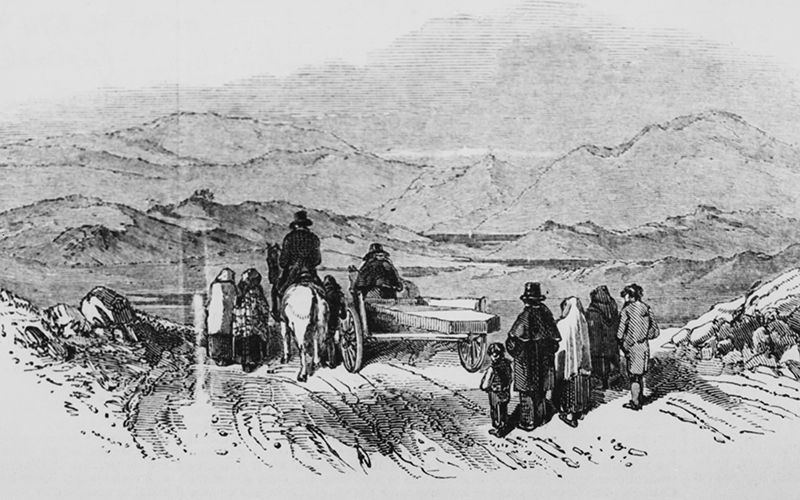
In October 1850, Father Thomas Hore, a priest from County Wexford, Ireland, embarked on a significant journey that would lead to the establishment of Wexford, Iowa. This migration was primarily motivated by the devastating Great Hunger that plagued Ireland during that period.
Father Hore, who had previously served as a missionary in America, returned to Ireland with a vision of creating a new life for his parishioners. With a congregation of 450 loyal members, he set sail from Dublin, making his way through Liverpool before arriving in New Orleans. Initially, they aimed to settle in Arkansas, but upon arrival, they found the land largely occupied.
Determined to find a suitable place for his community, Father Hore and many of his parishioners continued their journey to Iowa, where they discovered abundant land and a welcoming atmosphere reminiscent of their homeland. There, he purchased a thousand acres for just $1.25 per acre, allowing his parishioners to build homes and establish a church known as Immaculate Conception.
By 1854, the community had grown to around 400 members and had constructed two additional churches. Father Hore was the only priest in Iowa’s Allamakee County until 1855, providing pastoral care to Catholics in neighboring counties, including some in Minnesota.
After ensuring the stability of his new congregation, Father Hore returned to Ireland in 1857, leaving behind a thriving Catholic community of over 6,000 individuals. He continued his ministry in County Wexford until his death in 1864.
Today, Immaculate Conception stands as one of Iowa’s oldest Catholic congregations, with a mission statement reflecting the deep-rooted faith of its ancestors. The church remains a vital part of the community, serving about 100 parishioners and celebrating its rich heritage.
Life in Wexford, Iowa, is particularly cherished by older adults who seek a peaceful environment. The settlement has played a crucial role in the expansion of Catholicism in the region, attracting many Irish immigrants who followed in Father Hore’s footsteps.
For more information, visit the original article on IrishCentral.